

Quick answer: about 15 years in year one and 24 by year two
When comparing dog years to human years with the commonly used 15-9-5 method, the first calendar year is roughly 15 human years. The second adds about nine, bringing the total to 24; each later dog year adds roughly five. This is a convenient comparison, not a precise biological measurement validated for every breed or individual dog.
Treat a dog-years-to-human-years result as context, not as a health score or care instruction. Start with the dog's known calendar age, then use a human-age equivalent only as a rough way to describe development.
Why is the seven-year rule too simple for dog age conversion?
Multiplying every calendar year by seven is easy to remember, but it assumes that dogs develop at the same rate throughout life. Dogs grow and mature rapidly during their first couple of years. A dog years to human years chart should account for that early change and for later differences by breed, body size, and individual history; one multiplier cannot represent every stage well.
Under the seven-year shortcut, a one-year-old dog would be compared with a seven-year-old child. The 15-9-5 estimate instead compares that first year with roughly 15 human years. Neither number means a dog experiences the same life events or needs as a person of that age; the comparison simply illustrates how quickly early development happens.
Dog age charts may disagree because they start from different assumptions. One may present a general average, another may separate size groups, and a research-based model may measure something different again. Before relying on a result, check which method the chart uses and what it does not measure.
- Do not treat multiplying by seven as an exact conversion.
- Do not assume puppy development and later adulthood move at one constant rate.
- Look for the method and source when two charts produce different values.
How do you use the 15-9-5 dog age estimate?
The 15-9-5 approach assigns about 15 human years to the first dog year, then adds about nine for the second. That makes the rough total 24 at age two. For each full dog year after the second, add about five more human years to make a simple comparison.
The chart below shows that arithmetic. These values are not a veterinary assessment, a life-expectancy forecast, or a universal biological scale for every breed.
| Calendar age | Approximate human-age comparison | Calculation |
|---|---|---|
| 1 year | 15 | First year: about 15 |
| 2 years | 24 | 15 + 9 |
| 3 years | 29 | 24 + 5 |
| 5 years | 39 | 24 + 3 × 5 |
| 10 years | 64 | 24 + 8 × 5 |
| 15 years | 89 | 24 + 13 × 5 |
How do you compare a dog's age with human years?
To compare dog years to human years with this estimate, start with 24 for the first two years and add five for the third: a three-year-old dog's rough comparison is 29. For a five-year-old dog, add three adult years to 24: 24 + (3 × 5) = 39. This calculation demonstrates the method; it does not measure the dog's physical condition.
For age ten, count eight years after the second: 24 + (8 × 5) = 64. That does not mean a ten-year-old dog has the same needs as a 64-year-old person. It is only a convenient comparison for talking about a broad stage of life.
Avoid turning the estimate into an exact month-by-month result when the method is stated in whole calendar years. It also does not describe the details of puppy growth. If you need a more specific chart, choose one that names its source and keep the result qualified as approximate.
Why does the logarithmic research formula differ from 15-9-5?
Some articles also show the equation 16 × ln(calendar age) + 31 for dog age. Here, ln means the natural logarithm. The equation comes from research comparing age-related epigenetic changes in dogs and humans; it is not a day-to-day converter validated for every dog.
The American Kennel Club describes the underlying study as based on Labrador Retrievers. Its sample and research question differ from a broad 15-9-5 comparison. The two methods can therefore produce different numbers; that difference does not prove that either result is exact for all dogs.
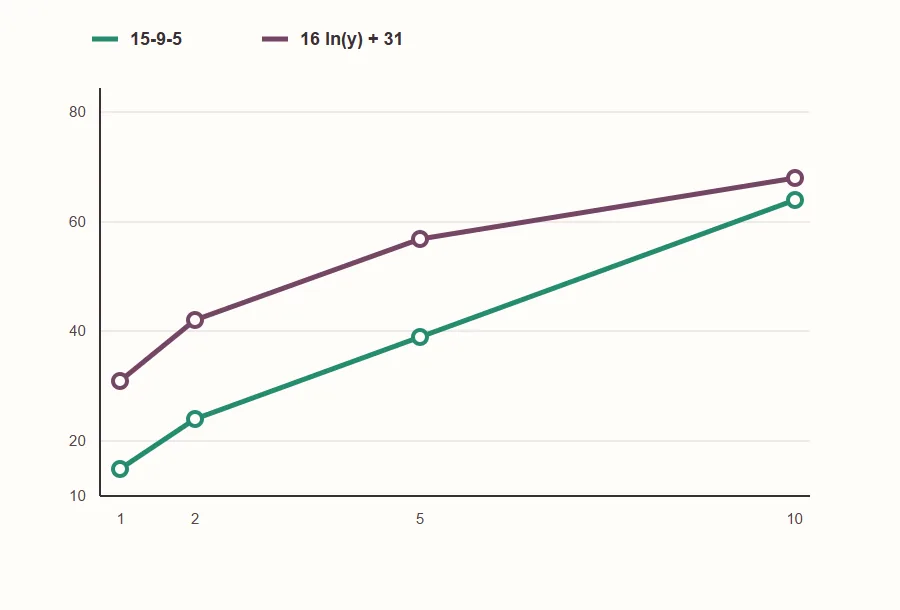
The lines show mathematical outputs from two different approaches; they do not measure your dog's biological age. In particular, do not use the research formula to predict an individual dog's health, remaining lifespan, or treatment needs.
Choose a method according to the question you are asking. The 15-9-5 approach is easy to explain as a broad comparison. A research formula needs its study population and limits beside it. Do not share a single figure as a definite answer without naming the method and its uncertainty.
Why can dog age comparisons vary by size and breed?
Small, medium, large, and giant-breed dogs at the same calendar age may not be at identical life stages. Size, breed, and individual development can affect how adulthood and later life are discussed. Some comparisons describe larger dogs as aging faster during adulthood, but that pattern is not a fixed rule for every dog.
Dogs within one breed also differ in genetics, health history, and living conditions. A line in a dog age chart cannot explain a particular dog's current energy or care needs. A reliable calendar age is a more useful starting point than its human-age equivalent.
If you use a size-based table, check how it defines weight bands, which breeds it groups together, and where its figures come from. A chart is not reliable simply because it shows separate numbers for small and large dogs. Do not use one comparison to infer an individual life expectancy or health risk.
- Weight boundaries for small, medium, large, and giant categories vary by source.
- Breed and individual history can matter even among dogs of similar size.
- A human-age equivalent is not a substitute for a care or treatment decision.
What information should you keep with a dog-age estimate?
Record the calendar age calculated from the dog's birth date first. Then note the comparison method, the source, and the fact that the human-age equivalent is approximate. If another chart gives a different number, you can see which assumption changed instead of treating one value as a correction of the other.
If the breed or birth date is uncertain, keep that uncertainty visible. An estimated birth year does not provide an exact month and day. When you give an age range, write down which record or observation supports it rather than using a human-age chart to fill in missing birth information.
You can enter a birth date in the site's age calculator to find elapsed calendar time. It does not calculate a biological age for a person or an animal; it only measures the time between the date entered and today.
How can you use the chart in a conversation with a veterinarian?
A human-age equivalent does not determine a dog's daily condition or veterinary care plan. If you notice a new symptom, pain, or a change in appetite or movement, discuss it with a veterinarian instead of explaining it away with an age chart. An online comparison cannot examine, diagnose, or provide individualized advice for your dog.
At an appointment, share the dog's calendar age, breed or best estimate, available health records, and when you first noticed a change. Ask which findings support the veterinarian's view of the dog's life stage and what remains uncertain. That keeps a general comparison from becoming the only information guiding a decision.
Frequently asked questions
How do you calculate dog years in human years?
For dog years to human years, the common 15-9-5 estimate assigns about 15 human years to the first dog year, adds about nine for the second, and about five for each full year after that. It is a general comparison, not an exact measurement for every dog.
Is one dog year really equal to 15 human years?
The figure of 15 is an approximate way to describe rapid early development. It does not mean a dog is biologically identical to a 15-year-old person or has the same needs.
Does the 15-9-5 chart change for small and large breeds?
The 15-9-5 approach is a general comparison and does not calculate a separate result by size. Breed and size can affect how later life stages are interpreted, so check the categories and source of any size-based chart.
Can I use 16 × ln(age) + 31 for every dog?
The formula is described in the context of research on age-related epigenetic changes using Labrador Retrievers. It is not a validated everyday standard for all breeds.
Does a human-age equivalent show my dog's health?
No. It is only a rough way to describe age. A dog's own signs and veterinary assessment are needed to understand health and care needs.
Sources
Source consulted for the comparison method and research context:
- How to Calculate Dog Years to Human Years — The American Kennel Club's explanation of the 15-9-5 comparison and the scope of the logarithmic formula drawn from Labrador research.